Trinity Health Aims to Improve Liver Cancer Screening Rates Through Physician, Patient Education Intervention

Jake Newby
| 5 min read
Jake Newby is a brand journalist for Blue Cross Blue...
Key Takeaways
- The Blue Cross Blue Shield of Michigan Foundation presented Trinity Health with a $10,000 Physician Investigator Research Award to increase hepatocellular carcinoma (HCC) awareness.
- HCC is a highly aggressive, common type of primary liver cancer with a low survival rate.
- One of the key components of this intervention is the design and delivery of HCC pamphlets to physician offices across West Michigan, which providers can use to educate at-risk patients.
- Dr. Antoine Sassine hopes this intervention will serve as a pilot for future interventions at other healthcare practices and facilities across the country.
About 1 in 4 at-risk patients receive recommended hepatocellular carcinoma (HCC) surveillance, according to a 2021 systematic review analyzing nearly 119,000 patients. HCC is a highly aggressive, common type of primary liver cancer. It has a low survival rate and is often caught late, despite existing guidelines recommending biannual screening for at-risk populations.
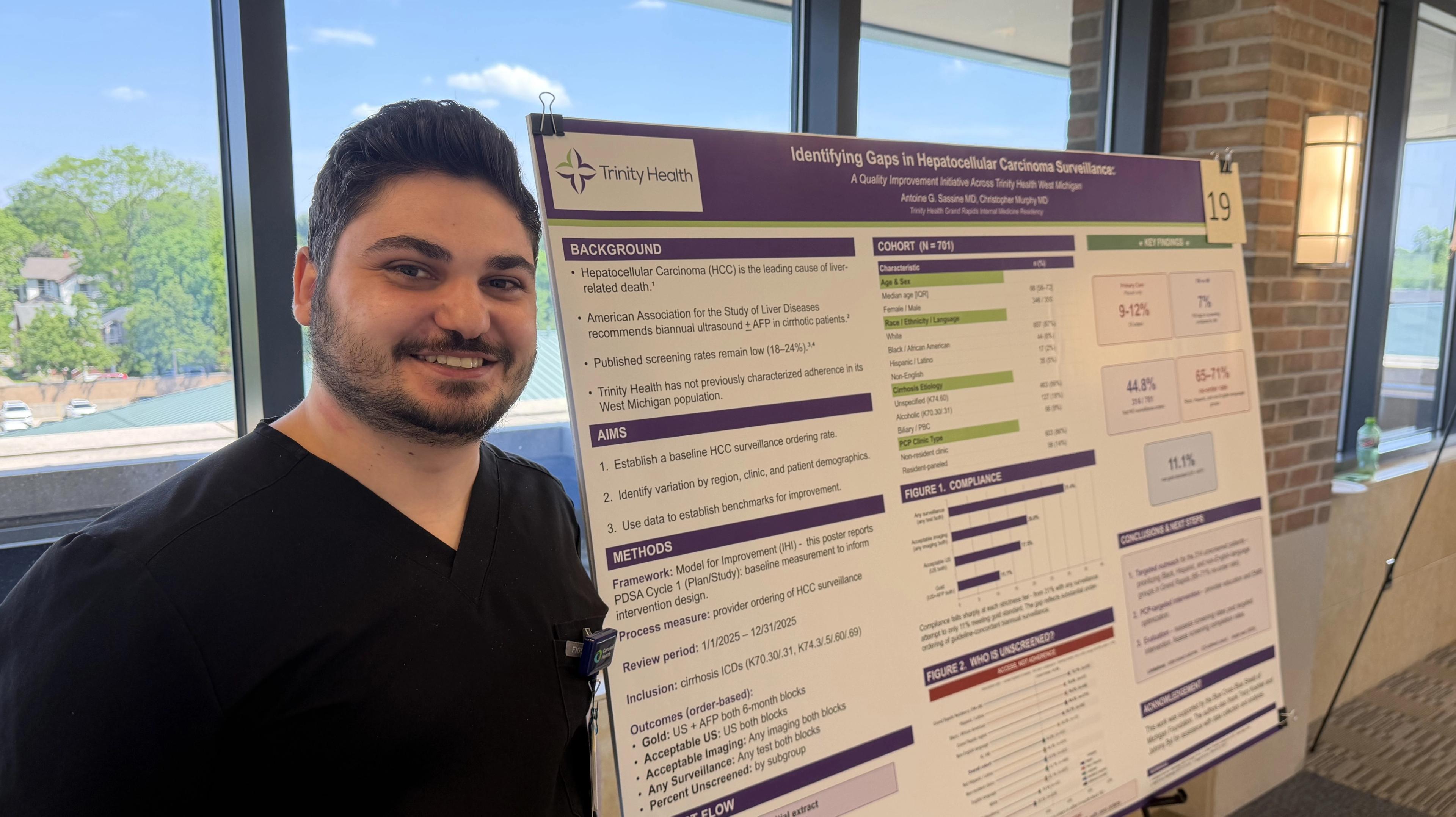
Trinity Health Resident Physician Dr. Antoine Sassine attributes low HCC screening rates partially to a lack of education and awareness, which he believes is correctable. That’s why he and his team are partnering with the Blue Cross Blue Shield of Michigan (BCBSM) Foundation to increase provider and patient education across West Michigan, courtesy of the $10,000 Physician Investigator Research Award the organization received in 2025.
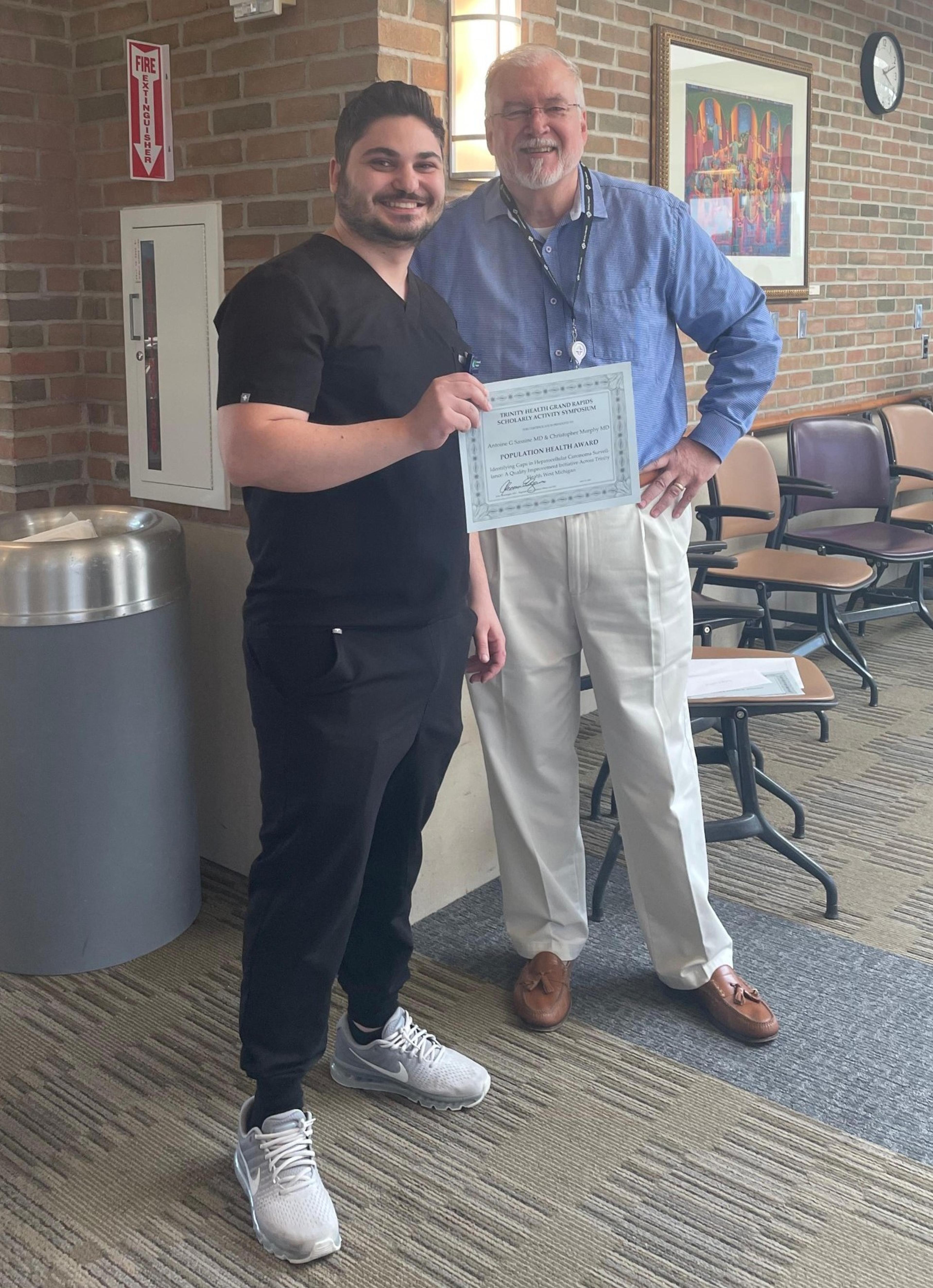
“The funding from the BCBSM Foundation has been tremendous in allowing us to deliver educational sessions to various providers at different clinics,” Sassine said. “They have allowed us to create pamphlets that we will soon distribute. These funds will allow us to showcase our project nationally, through poster presentations this fall.”
Why is HCC screening so low?
The American Association for the Study of Liver Diseases guidelines recommend people with cirrhosis receive a liver ultrasound every six months, and alpha-fetoprotein (AFP) blood testing, regardless of the underlying cause. Cirrhosis occurs when the liver becomes permanently scarred and damaged, interfering with its functioning and often leading to liver failure. Alcohol use is one of the most common drivers of cirrhosis diagnoses.
“Patients who actively use alcohol – especially long-term alcohol use – should know they are at risk of developing cirrhosis,” Sassine said. “That puts them at an increased risk of developing HCC.”
Through his research, Sassine has discovered a lack of awareness around HCC screening among underserved populations, noting the nationwide role of socioeconomic factors and language barriers in the lack of screenings.
“African American and Hispanic patients tend to be more likely to have late-stage HCC at the time of diagnosis compared to white patients,” Sassine explained.
The importance of providing HCC education to primary care physicians
One of the key parts of this intervention is HCC pamphlet delivery, a step within that program that is currently ongoing.
Sassine said people typically see their primary care provider (PCP) much more often than a gastrointestinal (GI) physician, and even though GI physicians historically lead HCC screening efforts, He believes there is value in more PCP involvement.
“It can be a big help if they are knowledgeable enough to know which patients should be screened,” Sassine said. “If not ordering the screenings themselves, they should be knowledgeable about which patients should get screened and refer them to GI to get the appropriate screening ordered.”
He added that his research indicates HCC screening is recommended much less by PCPs than other types of cancer screenings, potentially leading to missed screenings by at-risk patients.
“That opens up room for improvement,” he said. “So, one of the goals of our project is to improve HCC knowledge among our physicians. Some of our interventions include direct physician education. We’ve done around three to four education sessions for providers, from varying medical backgrounds, including residents as well as attending physicians.”
During these sessions, physicians learned more about:
- Who should be screened for HCC
- How to properly screen them
- How HCC screening can continue to be improved in their community
As part of this project, Sassine’s team will have pamphlets designed and distributed to PCP offices throughout West Michigan, for PCPs to then deliver to at-risk populations. This includes pamphlets written in Spanish.
Early HCC intervention helps patients avoid costly, long-term care
HCC screening not only gives at-risk patients a chance to catch the deadly disease early, when it is more treatable, but it can also save patients – as well as everyone else in the health insurance premium pool – money on expensive long-term care.
“By catching the disease earlier on, not only does the patient have much clearer, potentially more effective management options, but it also changes what their treatment may look like,” Sassine explained. “For example, HCC can be small enough to resect. However, if it is advanced enough, you start talking about much more invasive interventions.”
He added that often with late-stage HCC, patients require liver transplants.
“The cost that’s associated with that entire process – let alone the complications that can occur when a patient is immunosuppressed after a transplant – can be tremendously taxing on the patient, as well as the entire healthcare system.
Sassine hopes this intervention will serve as a pilot for future interventions at other healthcare practices and facilities, that can utilize the information Trinity Health is providing and utilize them within their own systems.
“Preventive services keep people healthy and keep health care affordable, because catching diseases early prevents patients from having to pay for expensive long-term medical costs” said BCBSM Senior Program Officer, Dr. Melissa Boguslawski. “HCC’s life-threatening nature makes early intervention crucial, and Dr. Sassine’s intervention should help more screenings take place in West Michigan, and hopefully beyond. It’s a research-based program that we’re happy to support and we look forward to seeing the results.”
Click here to learn more about the BCBSM Foundation’s Physician Investigator Research Award. And check out more BCBSM Foundation success stories below:
- The Eyes and Ears of the Court: How CASA Volunteers are Changing the Future for Foster Kids in Oakland County
- Manna Mobile Delivery Program Meets Northern Michigan Communities Where They’re at with Fresh Food Deliveries
- Breathing Retraining Practices Help Older Adults in Metro Detroit Better Manage Asthma Symptoms