
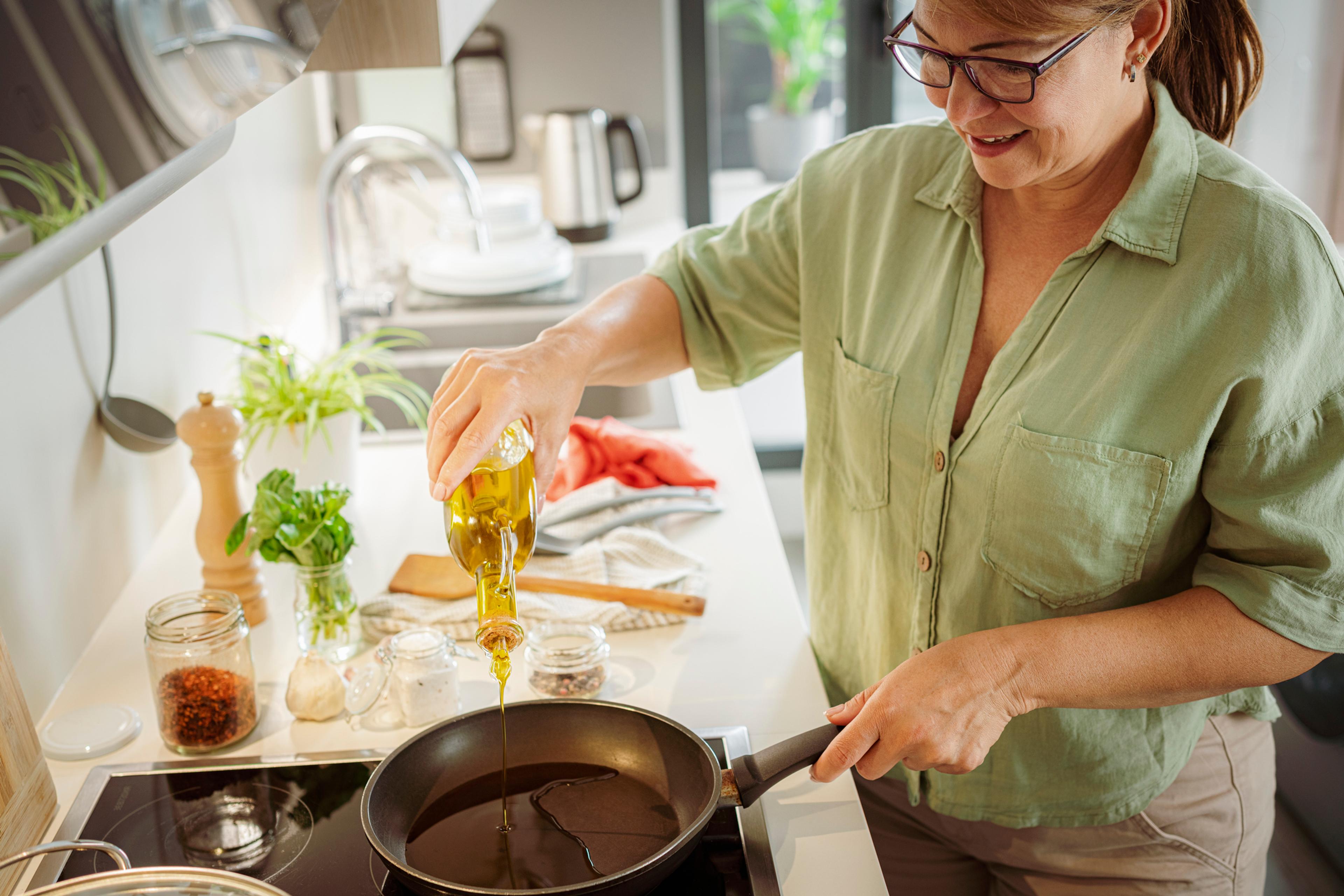
When you’re getting ready to cook a meal, what oil should you reach for?
In a recent episode of the A Healthier Michigan Podcast, host Chuck Gaidica speaks with registered dietitian Shanthi Appelo about how different oils affect both cooking performance and nutrition.
The importance of healthy fats
Their conversation highlights that fats are not the enemy — in fact, they are essential. Certain vitamins, including A, D, E and K require fat for proper absorption, and healthy fats play an important role in brain function.
Appelo explains that fats fall into two main categories: unsaturated and saturated. Unsaturated fats, found in oils such as olive and canola, are considered heart-healthy and are typically liquid at room temperature. Saturated fats, such as butter and coconut oil, are solid and can raise LDL, or “bad,” cholesterol when consumed in excess. While saturated fats are not off-limits, moderation is key.
The smoke point
Another important factor is how oils behave when heated. Each oil has a “smoke point,” or the temperature at which it begins to burn and break down. Olive oil, while rich in nutrients and flavor, is best suited for low to medium heat cooking or for use in salad dressings. For high-heat cooking, such as searing or frying, oils like canola or vegetable oil are better choices because they are more stable at higher temperatures.
Some oils are best used sparingly and without heat. Sesame oil, for example, is prized for its flavor but is typically added at the end of cooking or used in dressings to preserve its taste and nutritional value.
What to know about seed oils
The episode also addresses common misconceptions about seed oils. While social media often portrays them as harmful, Appelo notes that research does not support claims that they inherently cause inflammation. Instead, the concern lies in overconsumption, particularly through ultra-processed foods where these oils are commonly found.
Coconut oil, another popular option, can tolerate high heat but is high in saturated fat. Appelo recommends using it occasionally rather than as a daily staple, especially for individuals monitoring cholesterol levels.
Ultimately, the discussion emphasizes balance. A practical approach includes keeping a few staple oils on hand: olive oil for everyday use, a neutral oil like canola for high-heat cooking and a flavorful finishing oil such as sesame. Rather than eliminating fats, the goal is to use them thoughtfully as part of a well-rounded diet.
Listen to the episode What Oils Should You Be Cooking With and Why? to hear the entire conversation. A Healthier Michigan Podcast is brought to you by Blue Cross Blue Shield of Michigan. To hear more episodes on your smartphone or tablet, subscribe on Apple Podcast or Spotify or your favorite podcast app.
Image: Getty Images
Related: